| Artist |
Pissarro, Jacob Camille |
Pontoise is a medieval town some twenty miles northwest of Paris. Of considerable importance in the early history of France, mainly because of its strategic position, by the mid-nineteenth century the town showed a marked dependency upon the rapid development of Paris. The traditional rural economy of the town was based on granaries, mills, and market gardens, but to these activities were now added minor industries such as distilleries and tanneries. Located on the river Oise, the town also benefited from being a barge port, but the arrival of the railway in 1863–64 marked a dramatic upturn in its fortunes.
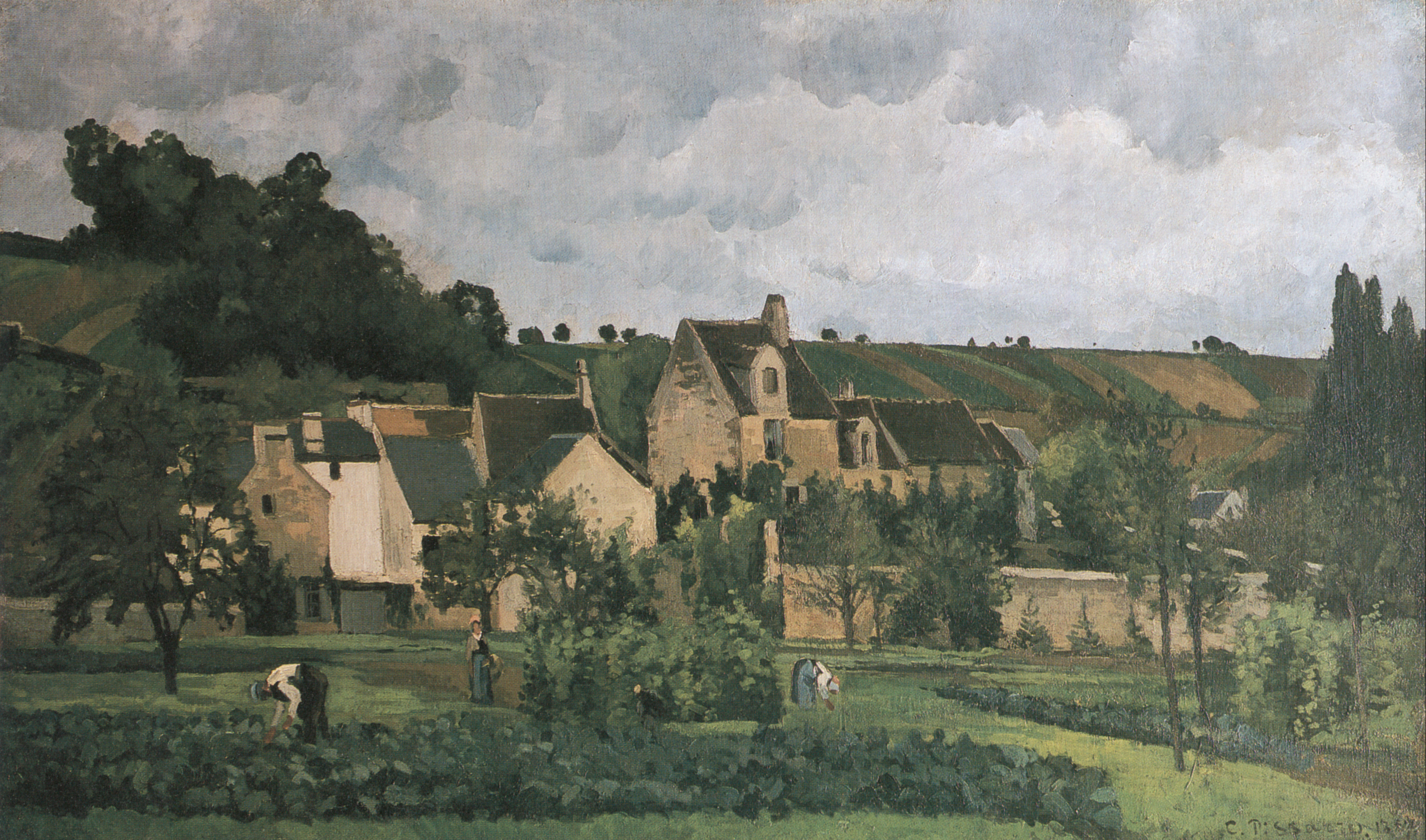
Pissarro lived in Pontoise at intervals over several years, beginning in 1866–68, when he resided in the area known as L’Hermitage in the northeast part of the town. Dominated by steep hillsides, L’Hermitage was notable for its market gardens. Pissarro subjected the area to close scrutiny in a series of large landscapes that he submitted for exhibition at the Salon. As a group, these constitute one of the most powerful and significant exercises in landscape painting of the period.
L’Hermitage at Pontoise has sometimes been identified as the work entitled simply L’Hermitage in the Salon of 1868 (no. 2016). The scale of the painting attests to Pissarro’s early confidence, but even more important are the formal qualities expressed not only in the spatial relationships between the natural terrain and the buildings, but also in the range of the brushwork, including the use of the palette knife. The successful rendering, in an even light, of the houses in the middle distance, with the almost abstract treatment of walls and roofs, helps to link the flat foreground to the rising background and towering sky.
The critic Émile Zola praised Pissarro’s work extensively in his criticism of the Salon of 1868:
“The originality is here profoundly human. It is not derived from a certain facility of hand or from a falsification of nature. It stems from the temperament of the painter himself and comprises a feeling for truth resulting from an inner conviction. Never before have paintings appeared to me to possess such an overwhelming dignity. One can almost hear the inner voices of the earth and sense the trees burgeoning. The boldness of the horizons, the disdain of any show, the complete lack of cheap tricks, involve the whole with an indescribable feeling of epic grandeur.”
Pissarro’s broad treatment of the subject owes a great deal to Daubigny, but the influence of Corot is also apparent in the compositional balance and tonal nuances, as well as that of Courbet in the handling of the paint surface. More importantly, it is apparent that these views of L’Hermitage by Pissarro exercised a powerful influence on Cézanne, a link possibly being provided by Zola. When intermittently working with Cézanne during the mid- and late 1870s, Pissarro looked again at these motifs. Cézanne then, in his own work, began to observe landscapes with a comparable degree of objectivity and to exercise a similar deliberation in his brushstrokes.
The picture was first owned by Ambroise Vollard, who became Cézanne’s main dealer. It passed into the collection of Sir Alfred Chester Beatty (1875–1968), a millionaire mining engineer who was born in New York but lived mostly in Britain before retiring to Ireland. He was a prodigious art collector with varied interests. At an uncertain date, the painting came into the possession of Fritz and Peter Nathan, who sold it in 1961 to the Wallraf-Richartz-Museum. |